

The Data Sovereignty Imperative: Why AI Is Only the Beginning
Business Continuity Is the Real Enterprise Imperative
For years, enterprises have accumulated data across applications, SaaS platforms, warehouses, data lakes, APIs, and systems of record, often without ever redesigning the architecture as a whole.
After decades of technology decisions, acquisitions, integrations, customizations, and technical debt, most large organizations aren’t operating a collection of independent systems. They are operating an interconnected dependency graph. When everything works, those dependencies are largely invisible. When one system fails, they can become a business catastrophe.
AI is now forcing enterprises to confront this architecture. Companies want to unlock proprietary data from application silos, centralize it, govern it, and make it available to data platforms and AI. This is creating a new quest for data sovereignty and freedom from proprietary systems.
But the most important implication is broader than AI. The same independent, governed, usable copies of data and processes required to make AI possible can also become the foundation for business continuity. Data sovereignty is therefore becoming not only an AI and governance strategy, but a business continuity strategy.
This complex landscape has changed the relationship with your data - and demands stronger SLAs from providers, such as guaranteed uptime, speed, scalability and perhaps most importantly fixed cost. [If you’d like to discuss Odaseva’s Data SLAs, request a demo here]
The AI Governance Quest Is Quietly Becoming a Business Continuity Strategy
The enterprise AI journey increasingly begins with governance. Companies need to understand what data they have, where it resides, who can access it, how it is governed, and how it can be safely made available to AI.
But governance inherently creates a requirement for trusted, independent, usable copies of data. Once those copies exist outside the originating application, they can serve a second purpose that is often overlooked: keeping the business operational when that application is unavailable.
This matters because modern enterprises have become deeply dependent on interconnected SaaS and cloud systems. A customer process may depend on several applications, APIs, workflows, data platforms, and downstream services. A failure in one component can therefore propagate through the entire stack. If a customer is looking for your 24/7 support, and this fails - so does the customer experience.
The question is no longer simply whether IT can eventually restore the system. The more important question is whether the business can continue operating while the system is unavailable.
This is why enterprises can’t wait until their AI initiatives are mature to establish an independent data foundation. The need already exists.
Governance for AI can become the catalyst for building the same independent data infrastructure required for business continuity. The opportunity is to move from backup as preservation, to data as an operational asset that can be protected, governed, accessed, and reused independently of the application that created it.
Business Continuity Requires a Platform That Serves the Entire Value Chain
The challenge is that business continuity cannot be solved by a traditional backup repository alone.
The system administrator needs large scale backup, protection, recovery, and high availability. The data practitioner needs access to trusted data in lakes and warehouses without depending on production systems. The business user needs simple ways to explore and understand data when the application itself is unavailable. AI requires governed, secure, contextual access to enterprise data.
A platform serving only one of these audiences leaves the enterprise with another fragmented architecture. True business continuity requires connecting the entire value chain: from the administrator protecting data, to the data practitioner making it usable, to the business user relying on it to operate.
Unplanned Outages: A High-Stakes Threat to Corporate Revenue
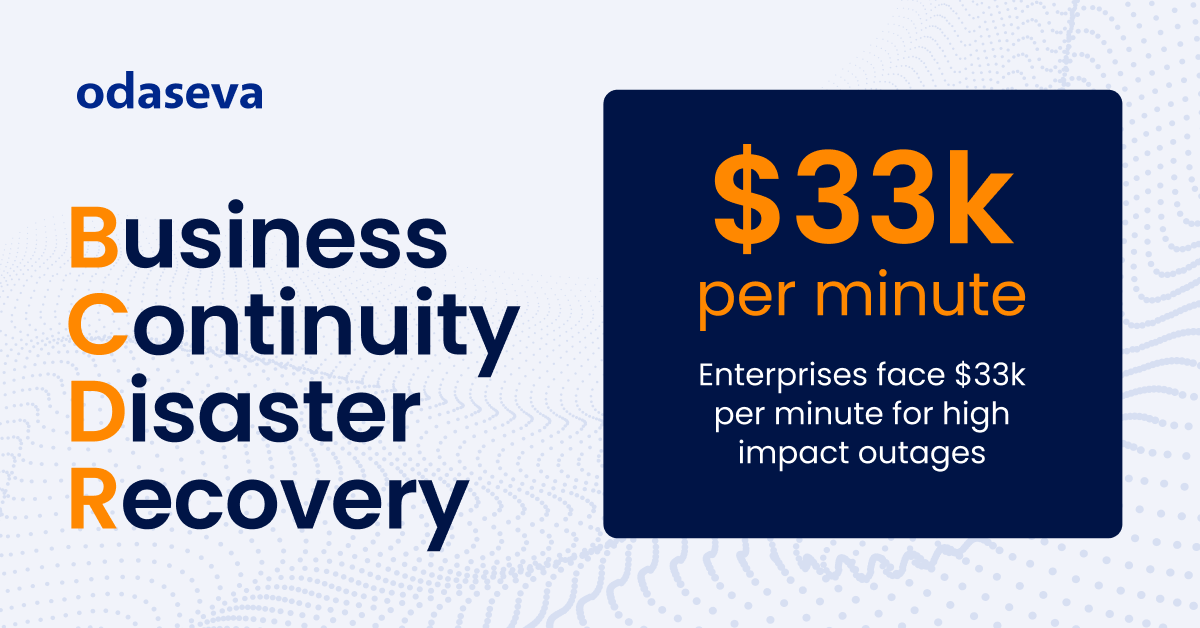
The economics of outages are becoming impossible to ignore. Uptime Institute's 2026 outage analysis reports that 57% of respondents said their most recent major outage cost more than $100,000, with approximately one in five reporting costs above $1 million. New Relic's 2025 research estimated a median cost of approximately $33,333 per minute for high impact outages and a median annual cost of $76 million among surveyed organizations. These costs extend beyond lost revenue to support and refund activity, engineering and management time, and longer term customer trust and churn. Enterprises can use the SaaS outage cost calculator to model this exposure.
The implication is significant. An independent data platform should not be evaluated only against the cost of backup or AI governance. It should be evaluated against the operational and financial exposure created by dependence on interconnected systems.
From AI-Readiness to Independence
The enterprise conversation therefore needs to evolve from data governance to data independence. True data sovereignty means that an enterprise can determine how its data is protected, governed, accessed, moved, reused, and ultimately used when the application that created it is unavailable.
This is the strategic opportunity behind an independent enterprise data platform. The backup repository becomes more than insurance. It becomes the foundation for data access, analytics, business continuity, and AI. Data can be protected independently of the application, made available to data practitioners through lakehouses and warehouses, surfaced to business users through accessible exploration and semantic capabilities, and made available to AI in a governed environment.
The Odaseva Excalibur Data Platform, announced at Dreamforce 2026, brings these capabilities together around an independent data platform designed to protect, move, and use enterprise data independently of application vendors. Its announced capabilities span BCDR and high availability, data federation, zero-copy data sharing, semantic AI orchestration, and query and API offload.
The significance is not simply that these capabilities exist together. It is that they address the same underlying enterprise problem from different angles:
- Administrators need resilience
- Data practitioners need data liquidity
- Business users need access and understanding
- AI needs governed context
An independent data platform can provide a common foundation for all four.
Beyond the AI Hype: Why Independence Is Essential for Operational Survival
AI has created an urgent reason for enterprises to liberate their data from proprietary systems, but companies do not need to wait for advanced AI adoption to act. After decades of technical debt and increasing dependence on interconnected SaaS and cloud systems, data independence is already a business continuity requirement.
The enterprise that establishes an independent and secure data platform today is not simply preparing its data for AI. It is reducing its dependence on the availability of individual applications and creating a foundation from which administrators, data practitioners, business users, and AI systems can continue to operate.
The future of data sovereignty is therefore not simply about owning a copy of the data. It is about having the freedom to use that data when the systems that normally provide access to it fail. That is the point at which data governance, AI-readiness, and business continuity converge.
Systems fail. Business-critical processes shouldn't. Odaseva Excalibur provides 99.99% availability for processes across Salesforce, SAP, and other SaaS systems.
Request a demo today to learn more.
View other stories

Odateam Spotlight: Kevin McLaren, Senior Business Development Representative

Odaseva in Action: A Real Life Use Case
.png)
A Year in Review at Odaseva: 2025


